
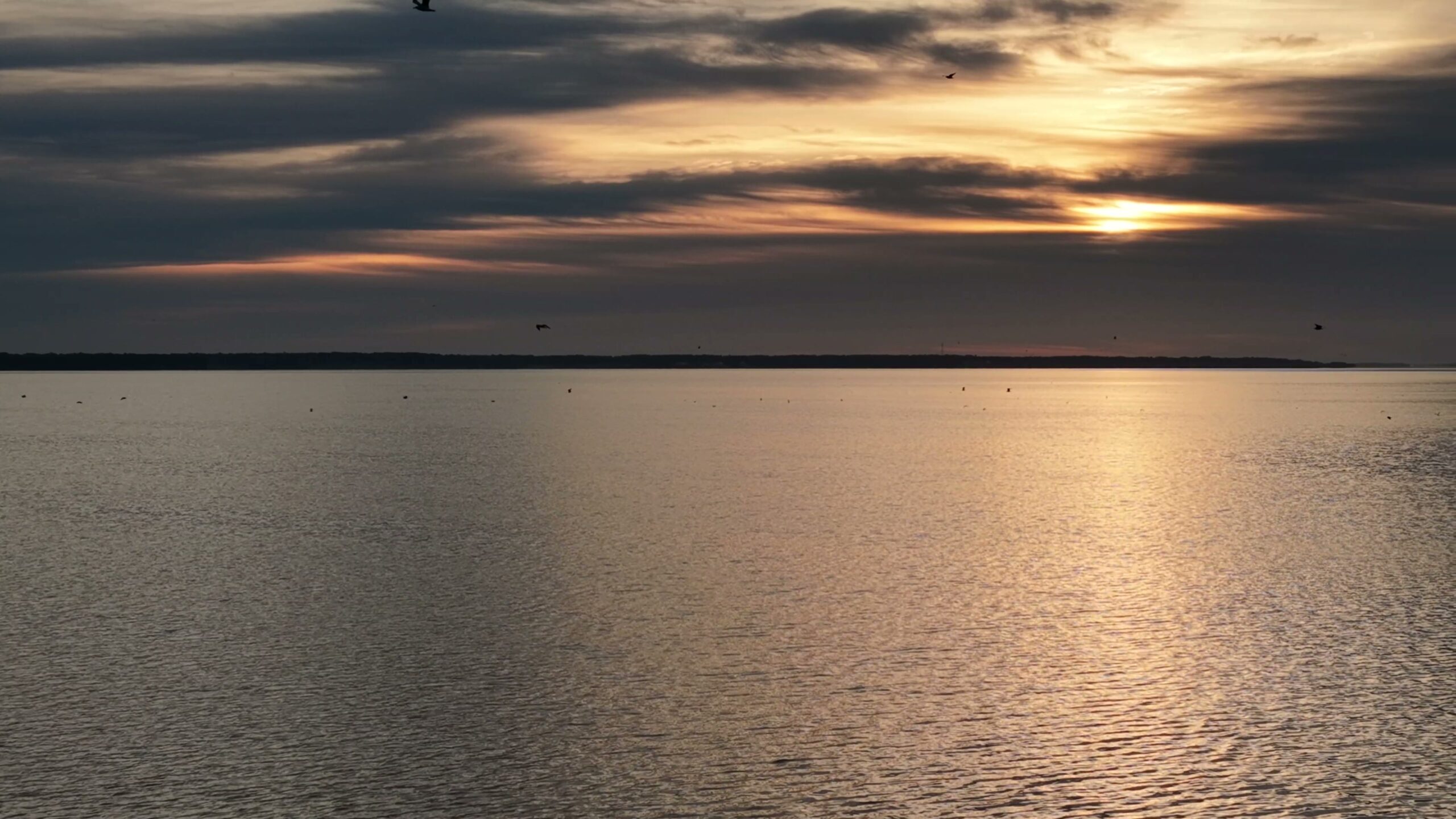
I was up before the sun this morning. Not for a client. Not for an inspection, not for a listing, not for a roof somebody needed documented before an insurance deadline. I drove out to the water, set the drone down on the bank, and waited for the light.
That’s it. That was the whole job.
Four minutes of nothing happening
If you watch that clip expecting something to happen, you’ll be disappointed. Nobody crashes. There’s no reveal. It’s water, and trees, and a sky that slowly stops being grey.
Then about two minutes in, the sun finds a gap in the cloud and lays a strip of gold across the whole lake, and two birds cross through it like they were paid to.
I didn’t plan that. You can’t. You can only be up there with the camera running when it happens.
What the sky does to your sense of a place
I’ve lived around here a long time. I thought I knew what this shoreline looked like.
I didn’t. I knew what it looked like from the bank — which is about five and a half feet off the ground, looking sideways. That’s one angle out of every angle there is, and it’s the one every person who has ever stood there has already seen.
Put a camera two hundred feet up and the same shoreline turns into something with a shape. You see how the trees follow the curve of the water. You see the sandbar that’s invisible from shore. You see that what you thought was the far bank is actually an island with more water behind it.
It isn’t that the drone makes an ordinary place beautiful. It’s that the place was always like that, and you had never once been in a position to see it.
That’s the part that gets people. Not the technology — the correction.
Flying for work teaches you things flying for fun won’t
Most of my flight hours are commercial. Rooftops, towers, real estate, infrastructure. That work made me a better pilot in ways recreational flying never would have. You learn to plan a flight properly. You learn airspace cold, because a mistake is your certificate. You learn to get the shot the client actually needs on the first battery, in the weather you’ve got, not the weather you wanted.
But commercial flying has a shape to it. There’s a shot list. There’s a deliverable. You’re solving somebody’s problem, and every decision you make up there runs through that filter.
This morning there was no filter. I put it up and looked at things. I held on a bank of cloud for forty seconds because the cloud was interesting. No client on earth is paying for forty seconds of cloud.
And I came back with footage I like more than most of what I shoot for money.
If you’re thinking about starting
A few honest things.
The rules apply to you even when nobody is paying you. Recreational flyers in the US still need TRUST — it’s free, it takes about half an hour online, and you have to carry proof of it. Your drone almost certainly needs registering. You need to know whether the airspace you’re standing in is controlled, and if it is, you need authorization before you take off, not after. None of this is optional because it’s a hobby. The aircraft overhead don’t know the difference.
Learn where you can’t fly before you learn anything else. Use B4UFLY or Aloft. It takes ten seconds and it’s the difference between a nice morning and a very bad one.
Keep it in sight. Not “I know roughly where it is.” In sight.
Your first fifty flights should be boring. Open field, good weather, no people, no pressure. Build the muscle memory while the stakes are nothing. Everybody who has ever put a drone in a tree did it on a flight where they were trying something slightly beyond what they’d actually practiced.
Go early. Sunrise light does something at 6am that you cannot manufacture at noon with any amount of editing. The air is usually calmer too, which means steadier footage. You’ll also have the place to yourself, which matters more than you’d think — fewer people to fly around is fewer ways to get it wrong.
Why I still do it
Because somewhere in the middle of turning this into a business, it would be very easy to stop seeing any of it.
You can fly a hundred roofs and stop noticing that you’re flying. The camera becomes a measuring instrument. The sky becomes a workplace. And the thing that made you want to do this in the first place quietly becomes a thing you do for invoices.
So every so often I go out before anyone’s awake, put it up over the water, and don’t film anything useful at all.
It makes me better at the paid work. But honestly, that’s not why I go.
Anthony Baltimore is an FAA Part 107 certified remote pilot and the owner of 25 Hour Drone & Videography, serving the Charlotte area with aerial inspection, real estate and commercial video work.
Leave a Reply